Wednesday, March 20, 2013

Radio: NPR's On Being with Maria Tatar


While I often post about radio interviews with fairy tale experts, few of them come close to this NPR interview with Maria Tatar. In the NPR series, On Being, which explores the big questions in human life, Tatar explores the world of fairy tales with Krista Tippet, an excellent and incredibly knowledgeable interviewer. They discuss the origins of fairy tales, the structure of fairy tales, fairy tales in popular culture, and fairy tales and children, all topics we have heard before, but they bring an immediacy and relatability to the discussion, bringing everything back to the big ideas we explore in our lives. (Click Here to Listen)

They discuss the idea of "Once Upon a Time," and how that phrase gives us permission to explore, to do things you would be afraid to do, to question things you wouldn't normally question because you are in a new and theoretical place.

They explore the "operatic beauty and monstrous terror" and the promise of "Happily Ever After" that combine to create fairy tales. The "Happy Ever After" is important, because it promises that there will be a way out. This, Tatar says, is why we can read them to children. No matter how dark it gets, there will be a happy ending.

Maria expounds upon her idea that fairy tales are not sacred texts. They are part of the "great cauldron of story." There is no original version, and each generation and culture changes the tale to speak to what they value and fear.

She states that there are no morals to fairy tales. The morality is highly ambiguous. However, there is wisdom to be gained from the tales. They discuss big ideas: sexuality and innocence, poverty and wealth, action and inaction, etc. She laughs that, in our modern cultures, we adapt the fairy tales so that we befriend the monsters, rather than defeating them. Fairy tales allow us to explore our values and ideas in a safe place.

She reflects on the fact that fairy tale themes are everywhere, in reality TV, Sex and the City as well as the fairy tale themed tv shows. Fairy Tale tropes are so entrenched in our culture, so primal, that they pop up in almost all of our stories. She feels that, in this time of great transition, we need the ancient wisdom of old stories to guide us, make us feel rooted.

She also discusses the very personal power of fairy tales to help you face your inner and outer demons. They are full of mysteries and puzzles that fascinate our brain that we use to help us figure out the world.

She tells of how she asks her students what books from childhood they brought to college. Most of the students don't remember the exact plot of the stories very well, but they always have a nugget of story that they cling to, something they strongly related to, a talisman they carry with them into this new place.

Finally, they talk about children, and how the liminal moment of bed time is a perfect meeting of generations, where those carring the nostalgia of fairy tales meet those who are hearing them for the first time. It is a co-storytelling, a time for asking questions and exploring what ifs, and what the story means for the world, and if it means anything at all.

It is an excellent interview, well-crafted and personal, bringing out the intimate and human nature of fairy tales.

And it ends with a clip from Game of Thrones, which is a mark of excellence in my book.


Monday, March 18, 2013

The Female Trickster and "Strong" Heroines


"What ya got in your basket, little girl?" "Weapons." - Buffy, "Fear Itself"

One of our favorite topics here in The Dark Forest is the idea of "strong female characters." In The "Empowerment" of Snow White, I wrote about if giving the leading lady a sword makes her "strong." In "Passive and Dumb" Heroines, I defended the more conventional fairy tale princesses. Recently, two articles came to my attention discussing very different angles of this issue:

Maria Tatar wrote an interesting article in the New York Times about two types of female characters: the Sleeping Beauty and the Female Trickster: While I find the Lady Gaga paragraph a little out of place, the rest of the article explores manifestations of both archetypes in popular culture:
"We've come a long way from what Simone de Beauvoir once found in Anglo-European entertainments: “In song and story the young man is seen departing adventurously in search of a woman; he slays the dragons and giants; she is locked in a tower, a palace, a garden, a cave, she is chained to a rock, a captive, sound asleep: she waits.” Have we kissed Sleeping Beauty goodbye at last, as feminists advised us to do not so long ago? Her younger and more energetic rival in today’s cultural productions has been working hard to depose her, but archetypes die hard and can find their way back to us in unexpected ways."
After listing many versions of the female trickster in pop culture from Buffy to Hanna to Lisbeth Salander to Katniss, she also makes a troubling observation:
"If male tricksters have traditionally been fixated on satisfying colossal appetites of all kinds, our new female tricksters—orphans, loners, and outsiders—are beleaguered and needy. At work, they become Cassandras, confident and shrewdly prescient women whose intuition and brashness cut through thickets of bureaucratic procedure. Yet, once work stops, they seem utterly lost. There is clearly something compensatory in the psychological fragility of these women warriors: their gains in intellect and muscle are diminished by moments of complete emotional collapse. Vulnerability continues to attract. Hence the intransigent presence of the sleeping princess, who remains central to many films and novels, despite the rising numbers of female avengers and investigators."
I wish I knew the heroinesTatar was thinking about when she said this. I do not think this "complete emotional collapse" occurs with all female tricksters. Hanna certainly never showed a loss of emotional control that was unwarranted. Certainly, there are some cases when this instance occurs, but there is a difference between voyeuristically delighting in a strong woman's vulnerability and creating compelling flawed characters. If a female trickster was a badass all the time, and never lost, and never wavered, she would be highly uninteresting. The same would be true of a male character. I do not think that moments of weakness of vulnerability diminish a character, but enhance it. The second article, published later, echos my feelings exactly.

The Hub's article,  "What We Talk About When We Talk About Strong Heroines in Young Adult Fiction," embraces all kinds of female strength:
"When we talk about strong heroines in young adult fiction, let’s celebrate the quiet(er) strength of realistic characters as well as the dramatic, death-defying strength of sci-fi, action/adventure, and fantasy heroines. Strength is more than physical prowess or fighting skills. There’s no universal way of being “strong,” and a character’s weaknesses are often what allows a reader to relate to him or her.
In my opinion, strong heroines are dynamic: they struggle, and through those struggles, they change. They are agents of action, rather than passive or reactive. Female characters can fall in love and still be strong. They can be bold or reserved. They can be feminine or they can be tomboys. There is no one way of being strong, just as there is no one way to be a girl. When we talk about what it means to be a strong heroine in young adult fiction, let’s make room for all the ways girls can exhibit their strength."
The article goes on to list many books that have female characters with other kinds of strength, not just the strength to fight and survive physically.

While I know this does not directly discuss fairy tales, it is an issue close to my heart, and an issue we encounter again and again as we see new fairy tale adaptations take the screen, and reread the originals. Is Cinderella not a strong female character for surviving years of physical and emotional abuse and then taking destiny into her own hands? Do movie executives think that the only strength needed to create a compelling heroine is to give her a sword? Don't get me wrong, I love me some chicks with swords, but we need to celebrate other strengths as well.


Monday, March 4, 2013

Movies: NPR's Bob Mondello on Fairy Tales for Millennials and Upcoming Adaptations

Molly Quinn in Hansel and Gretel get Baked

Bob Mondello over at NPR examines the new fairy tale movie adaptations that cater to teens and young adults coming out this year. He remarks upon Jack's lack of initiative in Jack the Giant Slayer, possibly commenting on or catering to the image of the millennial generation (I do not necessarily subscribe to this stereotype, being a cusp of millennial myself). They don't take destiny into their own hands, like Jack from the original tale, but are swept up in events beyond their control. This is perhaps appropriate for teens and young adults entering a work force that has no jobs for them:
"At age 6, as Disney long ago established, abandonment by your parents is terrifying. So is illness, so is the unknown, and so is that scary old dude down the street. But when you're 20, there's a whole new set of fears — fear of commitment, fear of getting pregnant, fear of unemployment. Or maybe of getting busted for drug use.
In the upcoming Hansel and Gretel Get Baked, a witch lures teens with marijuana, then eats them to stay young. It's a horror movie — clueless teenagers getting in trouble because they're clueless teenagers, just going with the flow, passively.
That's different from the more active tykes who populate storybooks. In the old English folk tale Jack and the Beanstalk, Jack is maybe 12, and a schemer. He steals gold from the giant, chops down the stalk, killing the giant, and lives happily ever after with his stolen gold. I'll leave it to parents to find a moral in that, but at least he went up the stalk on purpose; it was his idea.
In the new movie Jack the Giant Slayer, Nicholas Hoult is playing Jack as a 19-year-old who's kind of a slacker and is trying to impress a girl when the beans sprout under him and he gets carried up to Giant-land very much against his will. Once there, he proves less incompetent than you might expect, but he's basically reacting to things, not making them happen.
The girl is the one who's looking for adventure, though for plot purposes — she is a princess, after all — she'll spend most of her time getting rescued.
There's no real "risk" in any of this. The Brothers Grimm wrote stories that were actually grim — designed to scare children. Hollywood's new grown-up fairy tales may quicken your pulse a little, but they're centrally soothing. Yes, there's an army of giants coming, but pluck and optimism will carry the day — a reassuring thought if you're a 20-something and staring nervously at an uncertain, recessionary future. It's especially reassuring if that thought is couched in a fairy tale so familiar and comforting, you've half-forgotten it. So get ready for lots of grown-up bedtime stories."

He also updates us on the upcoming fairy tale movies:
"I was going to say we're not in Kansas anymore, but we kind of are. There are nine — count 'em, nine — Oz movies currently in the pipeline, including the prequel Oz: The Great and Powerful, a story involving Dorothy's granddaughter that's just called Oz, and a martial-arts oriented Oz Wars. Also dueling Pinocchios, from Guillermo del Toro and Tim Burton, the horror-masters behind Hellboy and Beetlejuice. Not to mention Angelina Jolie assaying the title role in Maleficent, which tells the Sleeping Beauty tale from the evil stepmother's point of view."
 NINE???? NINE Oz movies. Geeze, think of something original, people.

Monday, February 25, 2013

Books: YA Fairy Tale Reads from The Hub

Ladies and gents, many of you may know that in one of my lives, I am a YA librarian. The Hub is a fantastic blog that keeps me stocked with really awesome, high-quality YA books, recommended by both librarians and very articulate teens. Today, they gear up for "Fairy tale day tomorrow" (Is that a thing? Like Margarita Day?), by giving us some of their favorite fairy tale mash ups, and to my delight, I have read only two of them (Book of Lost Things is fantastic!)


book of lost things
"The Book of Lost Things by John Connolly (2007 Alex Award winner)
Set during WWII, The Book of Lost Things tells the story of David, a lonely and grieving boy who is drawn into the dark space between fantasy and reality. When he ducks into a dark crack in the garden wall while avoiding a bomber overhead, he’s sucked into another world, one where the characters from his favorite books are real. The world is being held hostage by a missing king with secret book, and David must find the king and the Book of Lost Things before he can return home. Familiar characters like Snow White, Red Riding Hood, and Rumplestiltskin are given new, often nightmarish life, in this Alex Award winner.
 kill me softly sarah cross
Kill Me Softly by Sarah Cross
Mirabelle Lively is a sheltered girl. Her guardians won’t talk to her about her parents or the way they died. Sick of half-truths and desperate for anwsers, Mirabelle runs away a week before her sixteenth birthday. Her destination is Beau Rivage, the town where she was born and where her parents lived and died. When she reaches Beau Rivage, Mirabelle finds a place that’s even stranger than she could’ve imagined. In Beau Rivage, fairy tales are real, and the stories are played out over and over again. Mirabelle has a part to play as well, but when she begins to fall for a boy who’s not the smug prince she’s destined to end up with, her feelings threaten the very existence of Beau Rivage and all who live there.
 Into the Wild Sarah Beth Durst
Into the Wild by Sarah Beth Durst
All her life, Julie’s heard stories of the Wild, the land her mother escaped from before Julie was born. Julie’s mother is Rapunzel, she of the long hair and the high tower. Rapunzel’s history in the Wild has been nothing but stories — until Julie gets home from school one day and her mother is gone and her house is disappearing into a deep forest. As the Wild threatens to take over her hometown, Julie ventures deep into the woods, determined to save her mother. On the way, she meets familiar fairy tale characters like Cinderella as well as characters from less well-known tales.
 Tale Dark and Grimm GidwitzIn A Glass Grimmly Gidwitz
A Tale Dark and Grimm and In A Glass Grimmly by Adam Gidwitz
Gidwitz’s wonderful Grimm series is technically middle grade, not YA, but it’s a funny, wry mash-up with enough dark and gory moments to appeal to teen readers too. Hansel and Gretel are the stars of this story, but their quest takes them through eight other fairy tales, originally recorded by the Brothers Grimm and repurposed in all their bloody detail by Gidwitz. The sequel, In A Glass Grimmly, borrows from Jack and the Beanstalk, the Little Mermaid, and more.
 Enchanted
Enchanted by Alethea Kontis (2013 Best Fiction for Young Adults Top Ten)
And finally, the book that inspired this post. I read Enchanted for the 2013 Hub Challenge, and I adored the cleaver way Kontis weaves together elements of familiar fairy tales into something new. Sunday Woodscutter is the seventh daughter of a seventh daughter, and like her siblings, Sunday is not even close to normal. Still, she manages to live a pretty normal life — until she meets a talking frog in the woods who turns out to be not a frog at all. Her kiss turns him back into a human, setting off a romantic adventure that features elements of at least half a dozen different fairy tales. The frog prince makes an appearance, obviously, as does Cinderella’s dropped slipper, Jack’s beanstalk (complete with fearsome giant), the old lady who lived in a shoe and many more." (Click here for Full Post)

Wednesday, February 20, 2013

Article: 10 Children’s Stories Guillermo Del Toro Needs to Adapt

This is an older article from the discerning folks at Flavorwire, but still very relevant! It seems that we are in an age where if you are a book, you need to become a movie. If you are a play, you need to become a movie. And in the case of something like The Producers or Hairspray, you need to be a movie, then a play then a movie of the play version. It was recently annouced that Guillermo del Toro was adapting The Secret Garden for the screen with screenwriter Lucy Alibar (Beasts of the Southern Wild). This lead to Flavorwire creating a top 10 list of children's stories they would like to see del Toro adapt. As we continue the fairy tale movie adaptation extravaganza of the past few years, (del Toro is also adapting Beauty and the Beast),  Flavorwire adds some alternative, and very exciting fairy tales to the list! Since del Toro believes that children's stories should “actually try and create a sense of darkness,” these would be perfect for him. (Complete post)

From the list:


Baba Yaga
"THE STORY: A recurring witch-like figure in Russian folklore, Baba Yaga, lives in the forest in a wooden hut standing on top of giant chicken legs and surrounded by a fence of human bones and skulls. Not content to be like other witches, she flies around in a mortar (using a pestle as her rudder, a broom to sweep away her tracks) and is not entirely good, nor evil, and is as prone to kidnapping children as she is to helping wandering souls.
WHAT DEL TORO SHOULD DO WITH IT: Baba Yaga’s living arrangements and mode of transportation alone are the kind of thing you wouldn’t be surprised to find in a del Toro movie. If he makes children the protagonists and keeps Yaga her morally ambiguous self (maybe less kidnapping, more tenuous team-up) this could be a good chance for him to make his own unique witch story and/or Hansel and Gretel reinvention. Because someone has to wipe Hansel and Gretel: Witch Hunters out of our minds."


The Red Shoes
"THE STORY: A spoiled and proud little girl gets fancy red ballet shoes that she refuses to take off in inappropriate places. As punishment when she starts to dance she can’t stop. Her adoptive mother dies, she injures her legs, an angel sentences her to dance forever even after she’s dead, and she has her feet chopped off to no avail. But she finds religious humility in the end, and it all works out.
WHAT DEL TORO SHOULD DO WITH IT: It might seem intimidating to share film title and inspiration with a Michael Powell and Emeric Pressburger movie. Like The Archers’, del Toro will also have to find a way to navigate away from the basic repetitive “girl can’t stop dancing, just like Kevin Bacon in that Footloose scene” nature of the story. The overt religious message (she’s basically punished for wearing gaudy shoes in church) might need to be tempered too – though one can’t help but imagine the Angel of Death from Hellboy 2 being the one visiting the girl." 

 
The Wild Swans
"THE STORY: A witch marries a widowed king and proceeds to turn her eleven stepsons into swans and gives them the boot. She tries to turn the sister into a swan too, but it doesn’t work because she’s too good, so she has to settle for banishment. Her brothers whisk her away where she meets a fairy queen who tells if she takes a vow of silence and knits nettles into shirts, they’ll help her siblings become human again. A king falls in love with her, she’s suspected by his archbishop of being a witch, she’s almost burned at the stake, but then manages to finish the shirts in time to save her brothers and herself.
WHAT DEL TORO SHOULD DO WITH IT: We’re not even sure del Toro would have to do much here since it’s already so clearly right up his alley. Give it a modern setting in the same way he fused fairy tale with Franco-era Spain in Pan’s Labyrinth, tinge the whole thing with a bit more darkness, and you practically have a kind of spiritual sequel to Pan’s."


Tuesday, February 19, 2013

OUAT Review Dump

Ladies and Jellyspoons, I apologize for getting so behind in this! I just closed my play, and I am now all caught up on our beloved and frustrating Once Upon a Time. Some of these episodes are vague, cloudy memories for me by this point, but I will do my best to re-recreate the joy and rage I felt when I first watched them.

The Cricket Game


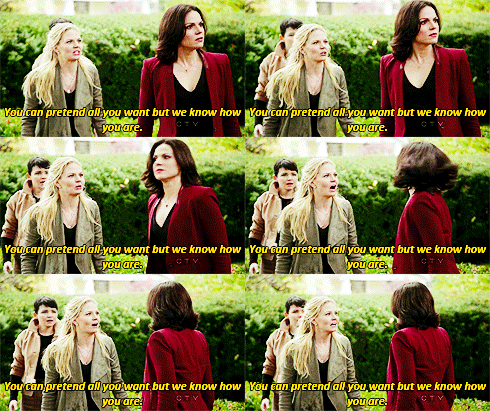
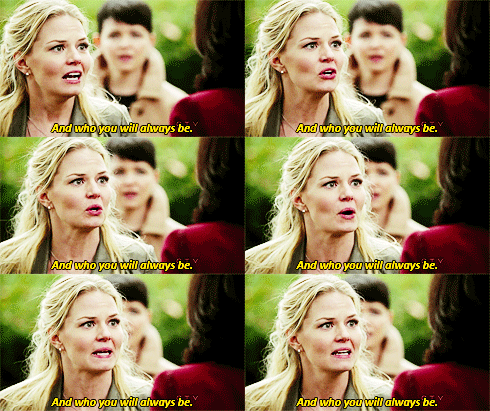
Gah! Heart-wrenching for Regina! She goes to the Snow and Emma welcome back party, and even though she saved them, and made it possible for them to come home, she is shunned and attacked. The conversation between Emma and Regina outside the diner was beautiful, and when Regina apologized for snapping at Emma, I just...oh the feels. I was so proud of her in this episode! She tries so hard. She keeps calm under pressure, she does not succumb to violence (until the end). She has some eeexcellent snark ("You got your PhD from a curse," "Because you know so much about parenting from the five minutes you've been with him," "Glad to see the sheriff's station is now a family business.") She follows what the law requires. And still, the town smacks her down. Understandably, since the evidence was stacked so high against her. (PS, did anyone else side with Regina about the doctor/ patient confidentiality thing? Bad form, Dr. Hopper).

While I sometimes love the Fairy Tale Justice in this small New England town, I am not cool with everyone deciding to kill Regina. In fact, there's a lot of group-think Killing People Will Solve All Our Problems in these episodes. Not cool, Storybrooke.

Loved the Snow and Charming sex scene, and how they still have a chance to emotionally scar their daughter.

Io9's review

The Outsider


(created by Frambouaz)

In which Belle has adventures and takes some really really stupid risks. I love Belle. She has some beautiful exchanges with Rumple this episode. The scene on the boat where she convinces him not to beat Hook to death is perfection! However, man, that flashback. Don't get me wrong, I was glad to see that Belle was fulfilling her dreams and using her brains to solve problems and vanquish beasts. However, she approached the fire cat without a weapon. Twice. The first time, definitely without a plan. Also, I did not see why she needed to change into the boobalicious adventure outfit to do it. As we see later with Jack, apparently women cannot have adventures in pants without their boobs spilling out all over the place. Unless you wish to distract your enemy with breasts, it is not a practical adventuring outfit. I do not fault Belle for this, as it is clearly a costumer fetish.

Also, did anyone else say, "Belle, do not go on to the boat that you can't see with a gun you have never used before? You have no idea what threats you will face. This is stupid and reckless." Yes, I know we are supposed to see from the flashback that she is capable of taking care of herself, but something about her bearing and her choices and her baby-deerishness on the boat make me highly frightened for her well-being.

The ending scene across the town line was heartbreaking. After all of Belle's devotion and love, which gave Rumple the strength to be a better man, all of it is gone in an instant. It was kind of satisfying to watch Hook get hit with a car, though.

Also loved Archie's funeral. I had worried they'd actually killed him because he was a disposable minor character (which I highly disagree with). I'm glad they gave him a proper, if premature, send off. I am a little irked that, after he reveals to Emma and Henry that he was alive, he disappears for ALL THE EPISODES. Not even a cameo. Archie, you are no longer needed as a plot device, so we will completely ignore your existence or the ramifications of your kidnapping.

And Henry, make up your mind. You always knew Regina was evil, you love her, you are creating an arsenal in case she attacks, you always knew she was innocent. Some consistency, please.

Io9's Review

In The Name of the Brother

(created by frekkenbok)

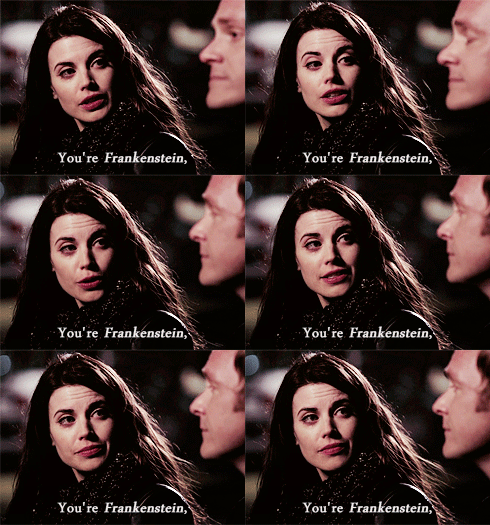
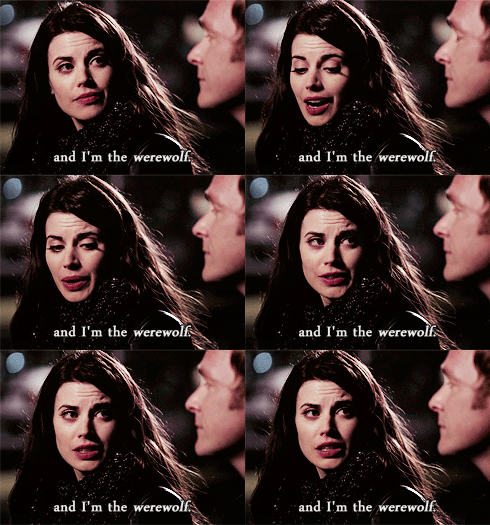
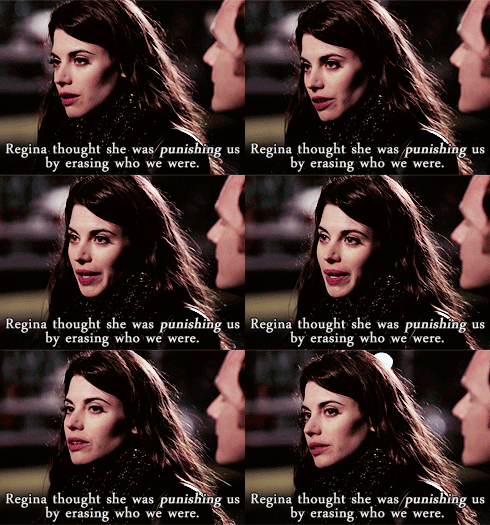
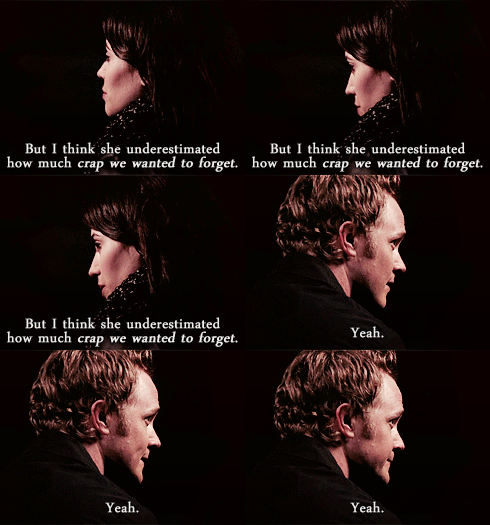
Ugh. I so wanted to love this episode. I am fascinated by Dr. Whale, and I love Frankenstein. However, here is my bone to pick with you, Once Upon a Time. You are all characters from books, yes? This is the world you have created, the rules you set up. Fairy tales were easy. There are so many gaps in fairy tales. All you need to do is have the basic symbols of the fairy tale: Cinderella, the shoe, the fairy godmother, the ball, the prince. Little Red, the wolf, the grandmother, the red cape. Snow White, the apple, the mirror, the stepmother, the dwarves, the kiss to wake her (Or dropping her to wake her). However, when you venture into novels, like Peter Pan, Alice in Wonderland, or Frankenstein, you have a hell of a lot more content to address. Snow White is an archetype that can be filled with anything you want. Hook actually has a fully fleshed out character. So does the Mad Hatter. Neither have back stories, so you can certainly take liberties up to that point. However, we know the entirety of Frankenstein's story, from his birth to his death and beyond. It is really fascinating stuff, all about personal responsibility. And Once Upon a Time used none of it. Absolutely none of it. He put life into a corpse, and there the resemblance ends. I thought the rules established in this world was that the books were written representations of the lives of these characters that live in the other universe of Imagination. The books may leave out information, but they aren't completely wrong.

My BF and I had an debate about this. He thought that it was ok for OUAT to change the story to fit the needs of the show. I would agree with that a little if I felt that 1) the story they told had value to the overarching OUAT plot line, and 2) it was saying something that could only be said without using the book. The pain and fear that Frankenstein goes through in the book, the idea that something he created or gave life to caused so much damage is a PERFECT parallel to what is going on with the Stranger. If he saves the Stranger, if he gives him life, the stranger could destroy the town.  Second, the main theme of Frankenstein is that he avoids responsibility, which causes destruction. That is exactly what he is doing in Storybrooke. He doesn't want to be responsible for this man's life or death so he runs away. He is reliving the fears and mistakes that lead to the most horrible chapter in his life, which he cannot deal with so he tries to commit suicide. This story, to me, seems so much more interesting than "I am not good enough for my father and cannot do anything right in his eyes so I will resurrect my brother and I can't even do that right, and now I am unsure of my skills as a doctor all of a sudden." </rant>

Anyhoodle, I loved the Monster to Monster chat. I hope they do more with Ruby and Whale's relationship that they started setting up in Season 1! I hated the fact that, again, the solution everyone seems to agree upon is, "When in doubt, kill someone." Loved the "We are not a group sheriff" line, because it was oh so true. Was really wondering what happened to Emma's Lie Detector power that only turns on when convenient to the plot? (Gif set of examples) Loved that Regina remained strong in the face of her mother...for like 5 seconds, and now I have no idea what happened to the Regina we have been developing this entire season, as we will see later.

Io9's Review

Tiny


I tend to agree with Io9 a bit that this episode held the very best and very worst of what OUAT has to offer. Not "Dreamy" worst, but a flavor of that. As much as I love love love Jorge Garcia (he is my favorite Lostian), this flashback felt like filler. The two things that came out of it were 1) Jorge Garcia in Storybrooke (yay!) and 2) Magic Bean. Now the BF gets on me about making judgments about the importance of things before we see the entire arc (and I am desperately trying not to do that with Regina, see below), but I do not foresee anything aside from those two plot points having any effect on later plots. It seems like OUAT is killing time with flashbacks, rather than using them to inform current events in a meaningful way.

Let us now talk about Regina, who is evil again. Cuz of mom. And she wants Henry back. Which bothers the crap out of me. Legally...LEGALLY, she still has custody of Henry. Emma has no case in Storybrooke for keeping him. It is only because of past wrongs and Fairy Tale Justice (rather than small town law) that keeps them apart. I nearly screamed at the TV when Snow said Emma didn't have to check with Regina about taking her son out of town. YES SHE DOES! Anyway....I do not like this weird amalgam Regina. She no longer has the full delightful evilness, but she does not have the struggling goodness either. She is kinda blandly in the middle. I am hoping this means that she is pretending to go along with her mother so that she can figure out her plan and then save the day in the last minute. The only real evil thing she has done so far is embiggen Tiny.

Speaking of not so evil things people have done, Snow says "Most people would let the giant die after what he's done." First, what has he done aside from throw some cars, and two, again with the KILLING!" What is up with this town?

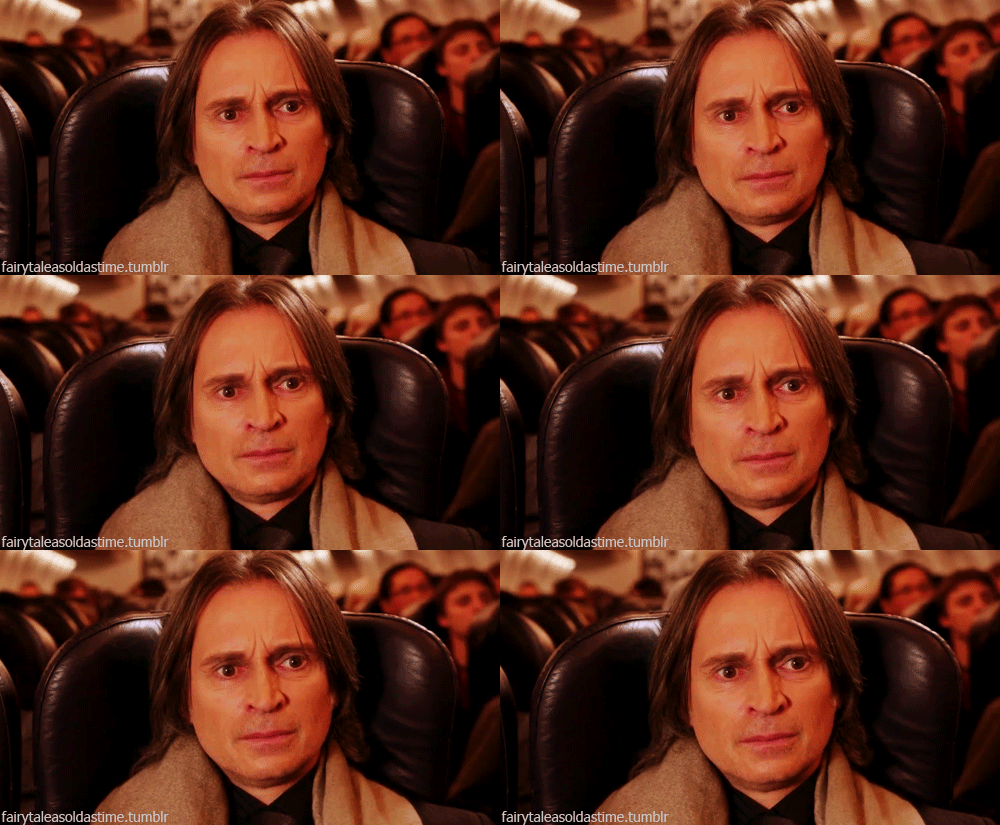
Other things happening in Storybrooke are really interesting and meaty, though! Ethan Embry investigating the town weirdness and trying to find an ally in Belle. Belle out of her depth and pushing people who love her away (the chipped cup was heartbreaking). Charming and Snow ramp up the discussion of where "home" is. I can't wait to see that conversation develop and bear fruit. And Emma, Henry and Rumple go on a road trip! So good! The episode breathed, and talked about real things, and you could see their relationships changing and developing. You saw Rumple vulnerable and scared and still pushing through. You saw Emma taking care of Rumple as she would a father in law (spoiler alert). So much tasty stuff in there! And that final panic-inducing push into Rumple's face as the plane took off. FANTASTIC.

Io9 review


Manhattan

(created by goshdarncute)

I KNEW IT! I KNEW Neal was Bae. SO awesome. The writing in the scenes between Neal and Emma and Rumpelstiltskin was really sharp. No one let anyone get away with anything, there were no easy solutions, everyone fiercely went after their objectives. Great work. Great payoff. And not only does Neal have a son, Rumple has a grandson whom he has previously threatened, but also built up a relationship with. More responsibility and family for a man who has been defined by his familylessness. Now, he will have to decide to accept the prophecy and let it pass, or to interpret "He will be your downfall" not as "he will be the reason you are taken down by Regina" or "if you kill him everyone will kill you," but as "I must dispose of the boy before he kills me." You would think he would learn by now not to take much stock in what you assume a prophecy to be.

I do agree with Io9 that the Pinocchio box reveal was pretty lame. All he needed to do is say "I know you are Baelfire." He did not need to write it down and reveal it dramatically. I was hoping for something bigger and better than that. Perhaps having to do with another theory that I have (which I will save for the end of this).

In Flashback Land, Rumpelstiltskin's wife is crazy. She clearly has multiple personalities or something. We see her in one scene saying that he shouldn't go off to the war and get killed because he is afraid of being a coward like his father. In the next scene, she is screaming at him for coming back to her and being a coward like his father. Is this the same character? What is happening? While I was not pulled by this flashback as I have been for others, Robert Carlysle is an amazing actor, the seer's make up was really cool, and it did solidify Rumple's devotion to Bae, even if he allowed it to get clouded by magic later.

And in Storybrooke, Hook is useless. He is not doing anything. He has had his revenge by taking Belle away from Rumple. Does he want more revenge? Why is he still here? He is there to make awkwardly threatening sexual statements and be the eye candy in the evil trio. And I do not like Cora with her hair down and her slim suits. It feels, and maybe this is on purpose, that she is trying to be like Regina so that Regina will like the "new Cora." The "not dressed in fairy tale clothes that reminds us of all the baggage we have" Cora. "The Hip New Mom" Cora. Also, Regina is getting lazy. She does not want to walk across a room and rummage through someone's purse manually anymore. She needs to conveniently make a big magic show for no one so Ethan Embry can record it on his phone. (PS, please let Stranger plot line pay off well!)

Did anyone else think that if Rumpelstiltskin had given Belle the dagger for safekeeping, he would not have given her a map to it? He would have just said, "Here, hide this in a safe place where no one will think to look," not "I have hidden my dagger. Here is a map to where it is in case.... I need you to get it? I want you to keep a map in a place where you need to carry around a reminder to where it is at all times, rather than just remember it so that it is very easy for someone else to find." It seems so much simpler to have Rumple put it in a lead box and drop it in the bay. Here's hoping he was smart and the map is a giant trap for the evil trio.

So my further theory on Bae. We are seriously getting into soap opera territory here. I think Neal is not only Bae, but Peter Pan. Hear me out. By rights, Bae should be like 80 year old, at least. Bae was 14 (?) when he got sucked down the vortex. This was after Rumple became the dark one, but not long after. Then, Rumple trains Cora in magic. Then, Cora grows up, has her own kid, and Rumple trains Regina in magic. He creates the curse, and then we are in Storybrooke for 28 years, during which Bae was uncursed. Unless Bae went to another land where he did not age for many years, then came to our world around the time of the curse (so that he is now 42ish), there is no way he could look like Neal. It would be a great reason for Neal's playful and nomadic life in "Tallahassee," compared with his suddenly "I am an adult and I hate it" demeanor in the "Broken." It would also tie very neatly into the Hook plot and give Hook a purpose in the show again. How appropriate would it be for Hook's nemesis to be the son of Rumple and Mila, a reminder of everything he hates, and everything he loves, a conflict that jives very well with the literary Hook.

Io9's Review

Tuesday, February 12, 2013

Travel: A Fairy Tale Hotel


Flavorwire treats us to some fantastic hotels inspired by literature, from an Ice Palace, to a romantic couples themed hotel, to one organized by the Dewey Decimal System! The one we are chiefly interested in, however, is the Maison Moschino in Milan, Italy, a fairy tale themed hotel! While Flavorwire showcases the Alice in Wonderland room, I loved the Little Red Riding Hood Room with it's strange wolf in comforter clothing!

While the other rooms don't strictly reference any one fairy tale, their design evokes strong images that crop up on many:

Life is a Bed of Roses: 

Luxurious Attic (with magical secrets hiding in boxes):

The Forest:

Sleeping in a Ballgown:

Sweet Room (very Hansel and Gretel):


Blue:

Half a Room (a bit Alice in Wonderlandy too!):

Zzzzzzzzz: