Showing posts with label gender studies. Show all posts

Wednesday, October 23, 2013

Articles: "Feminism" in Disney's Frozen and The Snow Queen

So I was full of lies when I said I wouldn't talk about Frozen anymore. Once Upon a Blog has really been cooking these last couple weeks, churning out really thought provoking articles on feminism, "feminisim," and blatant sexism in Disney's Frozen and other movies.


1) Disney's Ugly Princesses (Just Kidding. Being Pretty is a Requirement.)

There has been a lot of internet outrage when Lino DiSalvo, the head of animation for Frozen, claimed it was really difficult to animate women:
 "Historically speaking, animating female characters are really, really difficult, because they have to go through these range of emotions, but you have to keep them pretty and they’re very sensitive to — you can get them off a model very quickly. So, having a film with two hero female characters was really tough, and having them both in the scene and look very different if they’re echoing the same expression; that Elsa looking angry looks different from Anna being angry.”
Basically saying that it is more important for the character to be pretty than to express a range of emotions realistically.

This also brings back the conversation of how similar both the heroines in Frozen look like Rapunzel. I didn't realize how much until Once Upon a Blog showed this:


Ridiculous. It is like they did a test poll of what the most appealing face was and are cookie-cuttering it. OUAB has more thought provoking analysis. She also follows it up with a part 2: The Good Thing About Comas and Sleeping Princesses (?!) aka Ugly Princesses Not Allowed Pt 2, in which she explores the internet's outrage further, and branches out into the rest of the Disney Princess canon. 

--------

The Snow Queen by Julia Griffin


This post might be my favorite because it examines the false feminism of Disney's Frozen ("Look! We have TWO heroines!") with the very real portrayals of female strength in the original "Snow Queen." OUAB discusses The Feminist Fangirl's post about why she is not supporting Frozen because, in the original, not only the protagonist, but 99% of the supporting cast are strong women of different ages and types: The Robber Girl, The Robber Girl's Mother, The Snow Queen, The Princess, The Garden Witch, The Lapland Woman, The Finland Woman, Grandmother, and the Lady Crow. It would have been a fantastic opportunity for Disney to showcase all kinds of female physicality, not just the cookie cutter princesses above. OUAB's post focuses not so much on ranting against Frozen, but as a on a lament for the original, and the lost opportunity there. 

(Though if you want ranting, the Feminist Fangirl post is fantastic!: "That Disney feels it’s necessary to take a female driven, female dominated story and cut it down to one princess protagonist with a dashing male helper/love interest, is honestly disgusting and one of the most blatant examples of Hollywood’s lack of faith in women in recent memory." Go girl! )

Also check out this really great blog post by Laura Athena: The Snow Queen: Visions of Female Strength for a great analysis of the women in "Snow Queen" (though the formatting makes it a bit difficult to read).

-------


OUAB, as am I, is intrigued by the new trailer, which focuses on the sisters, and she discusses how few tales of sisterly love there are in fairy tales. The main protagonists are usually princess and prince, or sister and brother rather than two sisters. I can now sort of see how it is "The Snow Queen" again, only the Snow Queen and Kai are combined into one character: Elsa. However, it does not excuse the above article's point that they are lauding themselves for having two lead female roles, when they cut down a cast of 10 female roles and replaced them with male love interests and sidekicks. 

Tuesday, October 8, 2013

Video: Who is the Wolf? Two Red Riding Hood Interpretations


I have a long backlog of adaptations I wished to discuss, and when I was exploring them, I came across two very different Little Red Riding Hood tales, one a short film, one a webcomic. While most interpretations focus on a young and handsome stranger as the wolf, these give us a different look at the wolves in our lives.

The Red Hood from Danishka Esterhazy on Vimeo.

The Red Hood first examines the wolf as "men." All men have an animal inside them waiting to strike. The enemy is not a predatory stranger, but the supposedly safe husband. And then the wolf is the girl. The wolf is not a specific gender. It is a primal and desperate urge inside all humankind.

Once Upon a Blog has a wonderful write up of it, including background and words from the director about her vision for the film. My joy at Red's killing was not as complete as Gypsy's however. When the husband stopped, and did not attack her, I saw a moment of doubt, of softness, like he might want to talk. But then her lover did not give him a chance to speak. That moment of the husband's hesitancy diminished the triumph I might have felt in her actions.


Redden by Maya Kern is a short webcomic which sends Red, a little girl, off to visit Grandmother, a terrifying monster in the woods. She is helped along the way by a wolf who gives her his pelt to "stay pure." When Grandmother see's Red, she decides to keep her as an apprentice. She forces her to set traps for the wolves of the forest, and  Red tries to helps them get free. But one day Grandmother catches her, and Red must fight for her life. The end is beautiful and heart wrenching.

The literal wolf in the tale is a friend whom Red must struggle to protect against Grandmother. Grandmother is the real predator.

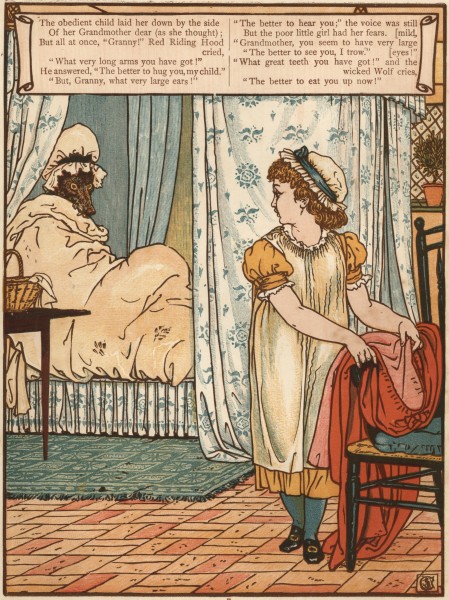
File:Walter Crane26.jpg

illustration by Walter Crane

This brings up an interpretation of the fairy tale that is seldom explored in adaptations. The motif of the replaced relative comes up often in fairy tales. A mother is killed and replaced by a stepmother who is evil. The Brothers Grimm changed a lot of mothers to stepmothers so that the mother would remain good while still exploring the idea of someone who should love you treating you horribly. While the wolf in the forest is male, he goes and usurp's grandmother's place, even going so far as to wear her clothes, get in her bed and imitate her voice. A grandmother who used to be loving and kind, but now is cruel. The wolf is actually the grandmother. A loved one who has changed. Or in fact, a loved one who should be good but is evil. It is an interesting aspect to explore.

There are many wolves in the world. I think that is why "Little Red Riding Hood" is so captivating. We have wolves in every culture, in every walk of life: the person who appears to be good, but really is not. As much as the predatory male stranger is a strong and resonant interpretation, it would be interesting to see adapters to go in other directions to confront the other wolves in our lives.

Thursday, September 26, 2013

Video: "Cinderonce" Makes Me Happy

I am catching up from my blackout period, so I know this is old news, but this video is one of my favorite things to come out in fairy tales this year: the story of Cinderella told through Beyonce songs.


It is brought to you by the fantastic artist, Todrick Hall who gave us Beauty and the Beat which went viral a year or two ago, and Cinderfella, a gay take on Cinderella which I had never seen until Once Upon a Blog's post

Everything in Cinderonce is lip syched, except for Todrick's vocals, but honestly, I didn't care! It was part of the homespun charm. It is a testament to how the themes of Cinderella still speak to a modern audience, and how the themes of Beyonce's songs transcend time. :-)

The best part is a cameo by drag queen Shangella as the fairy godmother! She is fabulous and makeovertastic. And Tiffany Daniels rocks the traditional Disney dress as Cinderella. The story is silly and tongue in cheek, but also very heartfelt at times.  

See more about the videos on Once Upon a Blog and Io9.

Here is Beauty and the Beat, a rendition of the song "Belle" set in the 'hood. 


Here is CinderFella, a touching gay retelling of Cinderella with a mix of Disney and modified pop songs (and sassy cameos from other Disney princes and princesses): 


Friday, September 20, 2013

ARTICLES: Fairy Tale Class, Unsatisfying Princes, Dancing in Red Hot Shoes, a Fairy Tale Conference, and Fairy Tale Fiction Initiatives!

There has been a lot of juicy fairy tale analysis and scholarship while I was gone! Here are a few meaty tidbits to sink your teeth into.


USF offers it's First MOOC (Massive Open Online Course) in Fairy Tales
At last, you don't need a bagillion dollars to take a college course in fairy tales!  The course is called "Fairy Tales: Origins and Evolution of Princess Stories" will be taught by professor Kevin Yee. Unfortunately, it already began, and we all missed it, but hopefully it bodes well for things to come. You can follow some of the work on Once Upon a Blog. InkGypsy took the course and is providing summaries and thoughts on each of the weeks! Here is her summery of Week 1 - Cinderella (Part 1) which has some really beautiful and insightful reflections from her classmates. Part 2 examine's Disney's Cinderella and it's contribution to the genre. Look for more soon!

-----


The Ending of Cocteau's La Belle et La Bete, and Disney's Beauty and the Beast is Supposed to be Disappointing. 
Once Upon a Blog discovered that, apparently, Cocteau meant for the transformation of the Beast into the prince to be disappointing in his highly influential La Belle et La Bete. He stated in an essay, "My aim would be to make the Beast so human, so sympathetic, so superior to men, that his transformation into Prince Charming would come as a terrible blow to Beauty, condemning her to a humdrum marriage and a future that I summed up in that last sentence of all fairy tales: ‘And they had many children.’” This is emphasized by the fact that the same actor played the transformed beast and the unwanted suitor at the beginning of the film.

Glen Keane, supervising animator for Disney's Beauty and the Beast, who referred to Cocteau's film for inspiration, agreed. "I never referred to him as anything but Beast,’ he answered. ‘To me he’s always been Beast. I always just believed that Belle called him Beast from the moment that he transformed… so whatever his name was before is not important because he was called Beast after that.’ Keane also went on to add, ‘matter of fact, when he changed into the prince, I knew everybody was going to be disappointed by that, because they fall in love with the beast’"

Truth.

-----


Once Upon a Blog, yet again, great scholar that she is, has researched the history of Snow White's cruel ending, where the evil stepmother is forced to dance in red hot shoes. Check out the link to see the historical torture device that may have inspired her fate. (I always think of this fantastic monologue when I read about the red hot shoes.)

-----


This year's American Folklore Society Conference is focusing on Fairy Tales! It is in Rhode Island from Oct 16-19th if you want to go. Really interesting topics. Click the link to find out more on SurLaLune.

-----

There are also two really exciting initiatives by my fellow fairy tale bloggers. First, Diamonds and Toads has launched Timeless Tales magazine! Each issue focuses on retelling of a specific fairy tale. She also includes a recording of the tale so you can listen to it. 

Something to Read for the Train has launched a similar, but more personal, initiative, A Grimm Project, where she is using each of the 242 Grimm tales as a prompt for her own creative writing! 

Monday, June 10, 2013

Fairy Tale Roundup: NPR's Ted Radio Hour Explores Storytelling, Vincent Cassell's Beauty and the Beast Movie, Bluebeard and Rape Culture, and a One Thousand and One Nights Adaptation

“Barbe Bleue” by Sorsha

NPR's Ted Radio Hour: Framing the Story
While this is not strictly about fairy tales, NPR's Ted Radio Hour is amazing. This one has several Ted talkers exploring what a story is, how to tell a story, and what is important for a story. Andrew Stanton (the main writer for Pixar), discusses what makes a good story. Tracy Chevalier (writer of Girl with the Pearl Earring) tells how she finds a story in an image. Chip Kidd (book cover creator - Jurassic Park and others) talks about how book covers tell their own story. Chimamanda Adichie (Nigerian author) elegantly examines the dangers of s single story (hearing one story about a place or a person and thinking it is the whole picture (my favorite!)

First Look at Christophe Gans' Beauty & the Beast: "I'll Eat You Up I Love You So"
Once Upon a Blog gives us a first glimpse of the crazy sounding Christophe Gans' Beauty and the Beast. This is the one with Vincent Cassel, not the Disney one with Emma Watson. The image and costumes look traditional, and not very revolutionary, but Gans promises to "surprise the audience by creating a completely new visual universe never experienced before and produce images of an unparalleled quality." It is adapted from the original novella written by Madame de Villeneuve in 1740, rather than the children's version published in 1760. While many novel adaptations have used the novella as inspiration (Beauty by Robin McKinley), apparently this is the first time it has been adapted for the screen. Check out the link for some insightful thoughts from Gypsy.

Of Keys & Bluebeards
Gypsy of Once Upon a Blog reflects on a blog post from by fantasy writer and fairy tale lecturer Theodora Goss, "On Bluebeard" on how men and women will often perceive situations differently. What men may perceive as an easy conversation, women may perceive as a potential threat. Gypsy examines the post in the larger cultural context, and then looks at the situation through the lens of fairy tales:
"Girls and women are taught from an early age to be cautious: "Stay on the path", "Don't talk to strangers" and, unfortunately, this is still the smart thing to do. "Wolves" are bad enough. "Bluebeards" (and Mr. Fox characters) are downright terrifying." 
Not all women may feel this way, but in our current cultural climate, I would not blame them if they did. Walking home late at night, I have often looked at the man following me from the metro as a potential threat, even if he looks like a nice guy. You never want to be wrong. It is unfortunate that fear has made women adopt a "Better Safe than Sorry" stance. Even more unfortunate that Bluebeard and Little Red Riding Hood are still very relevant today.

EDIT: Heidi at SurLaLune has added to the conversation and provided several Bluebeard resources for further reading.

Scheherazade: From Storytelling 'Slave' To 'First Feminist'
To end this on a positive note, here is an NPR interview with Hanan al-Shaykh who has written a new adaptation of One Thousand and One Nights, in which Scheherazade outwits her own Bluebeard figure, the king. The stories she chose to adapt involve women using their wits to survive.

Tuesday, April 9, 2013

Roundup: Sleeping with the Beast, Disney and Gender Roles, and Why Hollywood Can't Get it Right

“La belle et la bete” by Julie Faulques
La belle et la bete” by Julie Faulques

Hello Ladies and Jellyspoons!

This month has been crazy, so I have not had a chance to write as often as I like. Once May begins, everything should calm down, and I will be able to post more regularly. In the mean time, I give you a quick round up of fairy tale ephemera and news that has peeked my interest!

Jack Zipes on Disney's Snow White
Tales of Faerie takes on fairy tale scholar Jack Zipes, rebutting his view on Disney's Snow White. It chronicles a history of the film, lists what Disney changed from the original tale, and tempers Zipes' strong opinions on gender roles with a more middle of the road approach:
"I always come back to the fact that-whereas suppression of women was a real problem in the past, we can be grateful we live in a time where there is much more freedom for each gender to break beyond stereotypes. We don't have to resort to the opposite extreme and see all stereotypes as evil. I personally am not bothered by female characters who do housework. I currently earn my own living as well as taking care of my home, and it just doesn't occur to me to get offended."
I certainly enjoy traditionally female gender role activities as well as non-traditional ones. I feel it is just as limiting to say that women should not be seen cooking and cleaning as it is to say that they should only be seen cooking and cleaning. Thoughts?

Why Can't Hollywood Make a Decent Fairy Tale Movie?
Charlie Jane Anders at Io9 examines what he believes the recent fairy tales are missing. He explores the modern films that have flopped and the older ones (like Disney) that have stood the test of time and he finds those that last have "a sense of sincerity and good humor." Disney felt fairy tales should have this formula:
"To captivate our varied and worldwide audience of all ages, the nature and treatment of the fairy tale, the legend, the myth have to be elementary, simple. Good and evil, the antagonists of all great drama in some guise, must be believably personalized. The moral ideals common to all humanity must be upheld. The victories must not be too easy. Strife to test valor is still and will always be the basic ingredient of the animated tale, as of all screen entertainments."
Anders feels that modern fairy tale films "turn the strife into CG and the valor into banter." They are lacking that heart and sincerity that make us so attracted to things like The Princess Bride. Anders feels it is the perfect time for fairy tales because "fairytales become more relevant when people feel powerless — many of us actually are in the position of having made bargains with entities whose true names we're not allowed to know, thanks to the magic of mortgage securitization. At the same time, we still dream of being lifted up from our drudgery to noble status — and we dread having everything that makes us part of middle-class society taken away, if we fall through the cracks the way so many people have."

Perhaps the sincere story is what we need right now, without all the wink-wink, nudge-nudge that post-Shrek Hollywood thinks is necessarily for success.

Villeneuve's Beauty and the Beast: To marry or to sleep with?
Tales of Faerie challenges Jack Zipes again, this time on his translation of the "original" Beauty and the Beast tale (a novella by Madame Gabrielle de Villeneuve). She compares the original french to his translation. Zipes tells the story with the more well-known formula, where each night the Beast asks Belle to marry him, and she refuses. In the French version, however, it seems he was asking her each night to sleep with him. Which actually makes a lot more sense to me:
"Ce charmant spectacle ayant suffisamment dure, la Bete temoigna a sa nouvelle epouse qu'il etait temps de se mettre au lit. Quelque peu d'impatience qu'eut la Belle de se trouver aupres de cet epoux singulier, elle se coucha. Les lumieres s'eteignirent a l'instant. La Bete, s'approchant, fit apprehender a la Belle que de poids de son corps elle n'ecrasat leur couche. Mais elle fut agreablement etonnee en sentant que ce monstre se mattait a ses cotes aussi legerement qu'elle venait dele faire. Sa surprise fut bien plus grande, quand elle l'entendit ronfler presque aussitot, et que par sa tranquillite, elle eut une preuve certaine qu'il dormait d'un profond sommeil."
Strangely, it is not even "sleep with" in a sexual sense. He just wants to lay next to her, and when he does, he falls right asleep. It is kind of sweet, actually!

I will have a Once Upon a Time Review Dump coming soon!

Monday, March 18, 2013

The Female Trickster and "Strong" Heroines


"What ya got in your basket, little girl?" "Weapons." - Buffy, "Fear Itself"

One of our favorite topics here in The Dark Forest is the idea of "strong female characters." In The "Empowerment" of Snow White, I wrote about if giving the leading lady a sword makes her "strong." In "Passive and Dumb" Heroines, I defended the more conventional fairy tale princesses. Recently, two articles came to my attention discussing very different angles of this issue:

Maria Tatar wrote an interesting article in the New York Times about two types of female characters: the Sleeping Beauty and the Female Trickster: While I find the Lady Gaga paragraph a little out of place, the rest of the article explores manifestations of both archetypes in popular culture:
"We've come a long way from what Simone de Beauvoir once found in Anglo-European entertainments: “In song and story the young man is seen departing adventurously in search of a woman; he slays the dragons and giants; she is locked in a tower, a palace, a garden, a cave, she is chained to a rock, a captive, sound asleep: she waits.” Have we kissed Sleeping Beauty goodbye at last, as feminists advised us to do not so long ago? Her younger and more energetic rival in today’s cultural productions has been working hard to depose her, but archetypes die hard and can find their way back to us in unexpected ways."
After listing many versions of the female trickster in pop culture from Buffy to Hanna to Lisbeth Salander to Katniss, she also makes a troubling observation:
"If male tricksters have traditionally been fixated on satisfying colossal appetites of all kinds, our new female tricksters—orphans, loners, and outsiders—are beleaguered and needy. At work, they become Cassandras, confident and shrewdly prescient women whose intuition and brashness cut through thickets of bureaucratic procedure. Yet, once work stops, they seem utterly lost. There is clearly something compensatory in the psychological fragility of these women warriors: their gains in intellect and muscle are diminished by moments of complete emotional collapse. Vulnerability continues to attract. Hence the intransigent presence of the sleeping princess, who remains central to many films and novels, despite the rising numbers of female avengers and investigators."
I wish I knew the heroinesTatar was thinking about when she said this. I do not think this "complete emotional collapse" occurs with all female tricksters. Hanna certainly never showed a loss of emotional control that was unwarranted. Certainly, there are some cases when this instance occurs, but there is a difference between voyeuristically delighting in a strong woman's vulnerability and creating compelling flawed characters. If a female trickster was a badass all the time, and never lost, and never wavered, she would be highly uninteresting. The same would be true of a male character. I do not think that moments of weakness of vulnerability diminish a character, but enhance it. The second article, published later, echos my feelings exactly.

The Hub's article,  "What We Talk About When We Talk About Strong Heroines in Young Adult Fiction," embraces all kinds of female strength:
"When we talk about strong heroines in young adult fiction, let’s celebrate the quiet(er) strength of realistic characters as well as the dramatic, death-defying strength of sci-fi, action/adventure, and fantasy heroines. Strength is more than physical prowess or fighting skills. There’s no universal way of being “strong,” and a character’s weaknesses are often what allows a reader to relate to him or her.
In my opinion, strong heroines are dynamic: they struggle, and through those struggles, they change. They are agents of action, rather than passive or reactive. Female characters can fall in love and still be strong. They can be bold or reserved. They can be feminine or they can be tomboys. There is no one way of being strong, just as there is no one way to be a girl. When we talk about what it means to be a strong heroine in young adult fiction, let’s make room for all the ways girls can exhibit their strength."
The article goes on to list many books that have female characters with other kinds of strength, not just the strength to fight and survive physically.

While I know this does not directly discuss fairy tales, it is an issue close to my heart, and an issue we encounter again and again as we see new fairy tale adaptations take the screen, and reread the originals. Is Cinderella not a strong female character for surviving years of physical and emotional abuse and then taking destiny into her own hands? Do movie executives think that the only strength needed to create a compelling heroine is to give her a sword? Don't get me wrong, I love me some chicks with swords, but we need to celebrate other strengths as well.


Tuesday, February 5, 2013

Fairy Tale Catch Up: Bizarre Adaptations and Meryl Streep

Wow, guys. I have been in a black hole of putting up a play (come see The Pirate Laureate of Port Town if you are in the DC area!) We have finally opened, and now I can catch up on all the fairy tale news and ephemera that has been cropping up lately!

Click here to read <em>Hansel & Gretel</em> Is the Platonic Form of "So Bad It's Good"
Hansel & Gretel Is the Platonic Form of “So Bad It’s Good”
Io9 thinks Hansel and Gretel: Witchhunters is silly and fun! "If you're looking for a serious reinterpretation of the Hansel and Gretel story, this movie isn't going to cut it. Even the "dark" bits where the siblings try to figure out why their father left them alone in the woods are plain ridiculous. But if you want to laugh your ass off and see some witchslapping, it's the perfect thing. Gemma Arterton as Gretel is particularly adept at chewing the scenery in the most awesome way possible. What I'm saying is that you should turn your brain off and mainline some fairytale this weekend." I have yet to see it, but I must admit, I love the idea that Hansel now has diabetes from the witch candy and needs insulin shots. Honestly, I will see it for the fairy tale ass-kicking alone!


10 of the Most Bizarre Fairy Tale Adaptations
Flavorwire gave us a facinating list of strange fairy tale adaptations: Six-Gun Snow White, Catherynne M. Valente (set in the Wild West, and written by an amazing writer!), I Was A Rat!, Philip Pullman (about Cinderella's rat footman who didn't get turned back at midnight), The True Story of Hansel and Gretel: A Novel of War and Survival, Louise Murphy (Hansel and Gretel set in WWII), and more! Most of them seem pretty mainstream to avid fairy tale adaptation fans (like Anne Sexton's Transformations, and The Bloody Chamber by Angela Carter), but as widely read as those are, yeah, they are weird.


Adorable Gender-Swapped Fairy Tale Princes by Yudi Chen
Flavorwire, yet again, gave us this beautiful series of gender-swapped fairy tale art: a long-bearded Rapunzel, a merman saving an Inuit princess from drowning, a beastly beauty, a king jealous of his stepson, and several others that display a fresh look at fairy tales with surprisingly unforced tenderness.


Meryl Streep is a huge Witch in the Into the Woods movie
WHAT? Amazing. She is simply in talks for the role, and this is by no means final, but Meryl Streep would play a fantastic witch in the Into the Woods movie. While I am still nervous about Disney doing my absolute favorite musical of all time, this seems to be a step in the right direction.

Friday, November 9, 2012

RADIO: NPR's Interview with Maria Tatar on the Origins and Interpretations of Fairy Tales

Hansel and Gretel by Arthur Rackham 1909.

NPR's On Point did a fantastic interview with Maria Tatar recently! It delves into why and how the brothers collected the tales, fairy tales in popular culture, misogyny, Antisemitism and violence in fairy tales, and personal interpretation of fairy tales. While many of you have heard these topics discussed before, this conversation is fresh and interesting.

Maria emphasizes that the Grimm version is not sacred. Our stories that we remix and reinterpret and add meanings based on our own life experiences. I love that! While I do get frustrated when people take the tales and make them something totally other than I myself interpret them to mean or kowtow to the Disney version when there are more interesting versions available, it is important to remember that we all approach fairy tales with our own baggage. There is no right version. One of the best qualities of fairy tales is that they are so malleable. We don't get the internal monologue of the characters, just the actions, so we can infuse their actions with meanings we relate to. The tales belong to all of us. We each have our own Snow White, or Sleeping Beauty, or Little Red Riding Hood.

Go to the original page for supplementary materials. 

Tuesday, April 17, 2012

Article: Are Fairy Tale Villainesses the New Anti-Hero?


There has been a fluttering around the blogosphere due to a recent post in thinkprogress from Alyssa Rosenberg who takes the stance that fairy tale villianesses are the new anti-heros. So many critically acclaimed shows center around a strong, complex, morally ambiguous middle-aged male character (Breaking Bad, Mad Men, The Sopranos, Boardwalk Empire). Middle-aged women more often than not have more success in comedies:

"But if middle-aged anti-heroes are what we’ve decided give us an opportunity for moral sophistication as viewers and for complex, intriguing storytelling, where would we start in creating these kinds of women? It’s possible that one answer lies in a rising boom: fairy tale villainesses. Fairy tales are full of older women who are trying to hold onto the kinds of things about which great dramas about men are made: their power within their professional setting, their sense of sexual desirability, their status within their personal communities. In the trailers for Snow White and the Huntsman, we’re clearly meant to side with Kristen Stewart’s insurgent Snow White. But I’m intrigued by Charlize Theron’s evil Queen, who speaks of giving her fallen world the ruler it deserves, who commands armies and welcomes challenges.
And as production ramps up on the Maleficent movie, Angelina Jolie told People Magazine that she felt some ambivalence about defending her character (the movie will be told from the perspective of Sleeping Beauty’s rival for the throne): “It sounds really crazy to say that there will be something that’s good for young girls in this, because it sounds like you’re saying they should be a villain. [Maleficent] is actually a great person. But she’s not perfect. She’s far from perfect.” But why should we be so squeamish about suggesting that we should sympathize with female villains? Especially in settings where women have to be unusually tough to hold on to power and authority (which, let’s be honest, is not so different from the tightrope women have to walk today)?
If boys can grow up to sympathize with Tony Soprano, why shouldn’t women get a world where it’s permissible to sympathize with the stepmothers, crones, sorceresses and evil queens we taught were lying in our paths growing up? Reclaiming fairy tale villainesses wouldn’t just give us a crop of powerful female anti-heroines—it would help break a cycle of storytelling that valorizes younger and prettier women overthrowing older ones. Sisterhood is weird, and complex, and powerful." (Full Article)

Kyle Cupp from the League of Ordinary Gentlemen pondered whether sympathizing with villains would create a moral relativism in fairy tales whose defining feature is often the clear distinction of good and evil:
"I suppose sympathy with fairy tale villains and villainesses could lead into relativism’s dark woods if the villainy itself were considered to be something virtuous, but there’s nothing remotely relativistic in remaking images of unadulterated evil into morally-complex images of the human condition.  Which is, you know, morally complex.  Sure, Maleficent can turn into a dragon, laugh maniacally, and perform black magic, but she’s still a potential figure of humanity.  Flawed humanity, to be sure.  She really should have had staff meetings more than once every sixteen years: she would have learned early on that her orcish minions weren’t considering the aging process in their years long search for the princess Aurora." (Full Article)
Forbes wrote about how they would love to see more complex female characters in general. While there are several great ones currently on television (Leslie Knope is deliciously flawed), they are often few and far between:
"In a very real sense, female characters face the same challenges that female politicians face. Strong women are given the “uppity” treatment far too often,  described as haughty or cold or in other less-friendly terms. This is a huge barrier to entry when it comes to crafting a female anti-hero. You can see how precarious this becomes in a show like Weeds, though to be fair that show suffers from a myriad other problems." (Full Article)
I definitely agree that more complex female characters in the media would be a great thing! We are more often than not relegated to the stereotypes of virgin, whore, mother, and crone. Wholly good or wholly evil. However, there are many notable exceptions. The entire female cast of Game of Thrones, for example. The women are there, we just need them to be the rule, not the exception.

As for fairy tale villianess as the new anti-hero, I have some reservations. I believe that as long as the women are infused with humanity, like Maleficent in the new movie, and Regina in Once Upon a Time, it is a great thing. I don't think we should be holding up purely evil women as role models. I think that morally complex women, strong women, women who you sympathize with, struggle with, and watch them make the wrong decisions are more what we need.

We live in an age of absolutes, especially during this election year. I keep being confronted with the attitude that if you are a Republican, all Democrats are evil, and if you are a Democrat, all Republicans are evil. There can be no negotiation and compromise because each side is completely assured that the opposing side is lying and cheating and stabbing them in the back.

I think that a little moral ambiguity might actually do us good. Humanize those we assume to be villains, find the motives behind their actions, and slowly begin to sympathize them. I do not think we should condone their actions, but I think there is a lot to be gained by looking at the why. I think there are very few people in the world who go out and decide to do some evil that day. "Villains" always think that what they are doing is right. Context and motivation are key.

Creating more complex, morally ambiguous women (and men), might actually allow us to see life from our "enemies'" perspective and open the way for negotiations and compromise.

Tuesday, April 10, 2012

Article: Who's the Whitest of Them All?


Movieline posted an excellent article recently that brings up a crucial point in the midst of all these fairy tale movies: all the protagonists (and 99% of the supporting cast) are white. I don't think I have seen a fairy tale adaptation with a diverse cast, or a black, Indian, hispanic, asian, etc. protagonist since Brandy's Cinderella which was a delicious Benetton ad of color-blind casting). In a medium that is usually not restricted by historical accuracy, we should definitely be seeing more diversity on screen. The author of the article, Maria Aspen, hammers some points home:
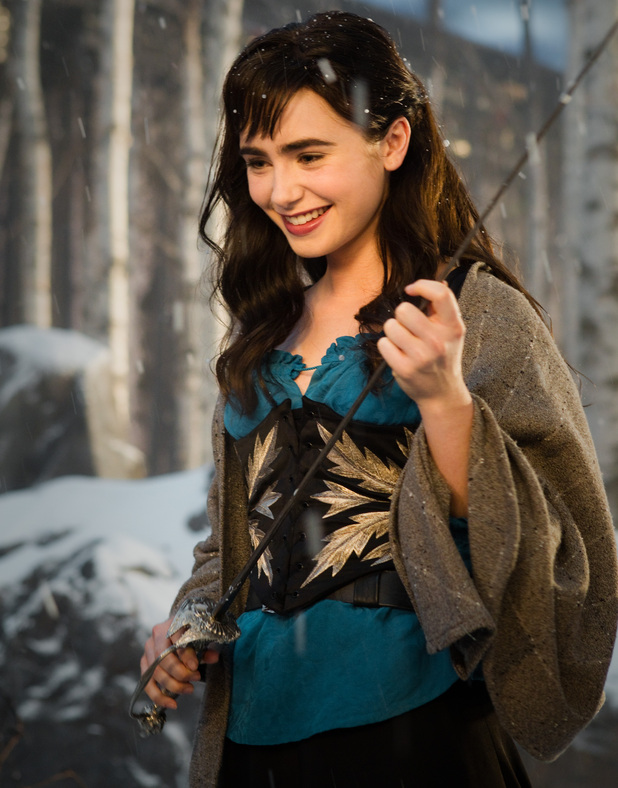
1. Paying lip-service to feminism is no longer enough. I love seeing movies with strong roles for women and heroines who actually get to do things. And yes, it’s great that Lily Collins’s Snow White learns to defend herself and beats Armie Hammer at flirty swordplay, and that Chris Hemsworth is going to teach Kristen Stewart how to fight the evil queen in her version of Snow White. All of this would be way more impressive if Drew Barrymore hadn’t done the same thing fourteen years ago in Ever After. If you want to be edgy, Hollywood, let’s move beyond grudging admissions that women can stick up for themselves and find something new to say about race or sexuality or all of those other Gender Studies words the Brothers Grimm didn’t have to deal with....
2. Stop appropriating culture without showing the people who made it...The color in Mirror Mirror is amazing, but it’s not even skin-deep. For much of the movie, the brilliant costumes and set designs hide the fact that there are very few nonwhite people wearing Eiko Ishioka’s crimson peacock dresses and gumdrop courtier costumes and black accordion stilts – which makes the final scene stand out all the more. The Bollywood homage is a fun break from tradition on one level, but it’s also deeply weird considering how little evidence there is that any non-WASPs actually inhabit this magic kingdom....

3. Think outside the casting box. I saw Mirror Mirror a few days after racists came out of the woodwork for The Hunger Games, which dared to cast black actors to play characters who were originally described as “dark-skinned.” As Anna Holmes pointed out at The New Yorker, that ugly reaction highlighted how many movie viewers expect characters to be white until explicitly proven otherwise – and Hollywood reinforces those expectations all too often, even when casting fantasies about imaginary lands where, you would think, anything goes. But no, it’s still sticking to the sidekick sidelines. The dwarves provided Mirror Mirror with pretty much its only diversity; at the very least, the movie could have included more people of color among the speaking courtiers and villagers and downtrodden castle servants. Snow White and the Huntsman, from its latest trailer, is going even more pasty-Eurocentric with its crowds of faux Crusaders. That’s not even considering the television variations; despite its modern setting and larger cast and serialized format, ABC’s Once Upon a Time has made room so far for only one regular non-white character. (NBC’s rival Grimm is doing a little bit better.) Just think what could happen if Hollywood got really radical and reconsidered how it casts its fairytale leads. In fact... 
4. Dare to rethink who’s the “fairest of them all.” It could be problematic and somewhat predictable to cast a person of color as the main villain in a fairytale, especially if all of the heroes are white. (Though I think Michelle Yeoh or Angela Bassett could mop the floor with Julia Roberts.) Future fairytale filmmakers could also consider looking for a prince who’s slightly less Caucasian than Armie Hammer – he’s charming and nice to look at, but I suspect there are plenty of attractive young actors out there capable of handling a role where the heavy lifting entails imitating a puppy. But the most interesting possibility, and the one I’d most like to see the next big-budget, postmodern Hollywood fairytale attempt, would be to cast a young woman of color as Snow White or Belle or Red or any other virginal, virtuous, smart and beautiful heroine, especially if she’s a character whose beauty has traditionally been defined by the paleness of her skin. These stories have been told for centuries, and by now they’re desperately in need of some real reinvention. Challenging their most outdated assumptions about who and what is beautiful would be the easiest – and most interesting – way for Hollywood to make its next round of adaptations far more worthwhile. (Full Article)

I am all for this! What do you folks think? What would be your ideal non-white casting for the next fairy tale princess?

Books: What about the Prince? An Interview with Author Christopher Healey


With all this talk about kickass princesses, the princes are feeling somewhat neglected. Even ordinary princesses who do nothing heroic have the story named after them, rather than the prince (See my opinion on Passive and Dumb Heroines).

Enter author Christipher Healy, who has written a book about those neglected princes, The Hero's Guide to Saving Your Kingdom. I will leave the book details to other bloggers, but in a recent interview on the blog Stories are Good Medicine, Healy described the way he created his fairy tale characters by digging deep into the original stories to glean what sort of person would make those choices:

Question: Christopher, your book has four main protagonists – Frederic, Gustav, Liam and Duncan — all former Prince Charmings (er, I mean, Princes Charming. As your character Duncan would remind me, the noun is made plural, not the adjective).  Where did you come up with their off-kilter personalities? And tell us the truth – which one is closest to your own?
Christopher: Well, the original fairy tales don’t give us much to go on, but it was still important to me that my princes’ personalities made sense with what little we do know of these guys already. I asked myself, for instance: What do we know about Cinderella’s prince? He can dance. He’s sophisticated. And he’s got noble ladies swooning over him. But beyond that, we don’t know much. So I took what Charles Perrault gave me, and got creative with the rest. From that starting point, it’s not too much of a stretch to think that Prince Frederic is probably not very outdoorsy, perhaps a little too focused on his fashion choices, and (to put it mildly) not the most daring guy in the world.
I did the same for all the princes. Rapunzel’s prince wants to rescue her, but never thinks to get a ladder — so Gustav is the kind of guy who rushes into things without thinking. Sleeping Beauty’s prince actually rescues an entire kingdom in his story, and gets major kudos for it — so Liam bases his entire identity on heroics and has a bit of an ego about it. Snow White’s prince gets lucky by wandering through the forest and stumbling upon a bewitched princess to kiss — so Duncan is a carefree oddball who spends a lot of time walking the woods by himself, just waiting to see where life takes him next...
Question: Your book plays with the princess stereotype as well. How did you decide on your princess’ personalities?
Christopher: While I did work to make sure that my princesses were different from previous depictions of those same characters (especially their film incarnations), I crafted their personalities the same way I did the princes. I built them out of the original stories.
Cinderella worked hard labor for years, so she’s tough and strong. Rapunzel has the power to heal people with her tears (in the original tale), so here she’s got a bit of a savior complex. Sleeping Beauty was hidden away and catered to for her whole childhood, and has thus ended up somewhat spoiled.
And Snow White, just like her prince, spends a lot of time wandering the forest and chatting with wildlife, so as it turns out, she’s actually a good match for Duncan.
But those were just starting points for the princesses. The ladies come into the spotlight a whole lot more in Book II, and the further changes you’ll see there should come across as a natural evolution for the characters.  (Full interview)
I love this method of finding character! So many people complain that fairy tale characters in their original form are too flat and uninteresting, and that is often the case. We never get to see what they are feeling, or what they are thinking, just what they do. But I think its a great game to extrapolate what sort of person they are from the actions that they take. 

Tuesday, March 27, 2012

Article: "Passive and Dumb" Heroines?


The New York Post recently printed an article about how Snow White went from being "passive and dumb" in the older interpretations to a girl-power icon in the three recent incarnations of the fairest of them all (Full Article).

I always kind of cringe at the "passive and dumb" interpretation. It is always assumed that Snow White was duped three times by the same woman in disguise, selling a comb, a corset, and then an apple. Fool me once, am I right? No one ever thinks of mitigating factors, like perhaps she was left alone in the house all day, and not allowed to talk to anyone. The other times she is surrounded by men. Maybe she desperately needed someone to talk to. Speculation, yes. Or, she was SEVEN YEARS OLD, and we should cut her some slack. I think perhaps my favorite interpretation comes from the mini-series 10th Kingdom (which I will post separately on later). Snow White tells an incredibly faithful re-telling of her story to Virginia, the heroine, and adds a little bit of the "why" at the end in a way that tugs at my heart every time.

Embedding has been disabled, so here is the link: The 10th Kingdom: Virginia Meets Snow White.

Everyone always rails about the anti-feminist message of fairy tales: Snow White was docile, stupid and domestic, and then looked good dead. Sleeping Beauty was conned into pricking her finger and then was asleep for most of the story. Cinderella cried when she was abused, and had her fairy godmother do everything for her. Very rarely do we talk about the good qualities of these characters, or allow them to have normal human frailties.

Snow White was thrown out of her home at a young age, hunted, managed to convince the huntsman not to kill her, and had to survive in the forest until she found the dwarves. She had to live with the shadow of "going to be murdered" while cooking and cleaning, and being left alone all day.  (And btw, cooking and cleaning, not a bad thing. People always thing those are the sign of the evil patriarchy, but I quite enjoy doing them.) Snow White earned her keep. She learned the value of work, after living her life as a princess. Each time the evil queen came, Snow White grew more clever with how to handle strangers. At first, she doesn't suspect the woman with the ribbons. The woman with the comb, she refuses to let in to the house at first. Finally, she watches the woman with the apples eat a bite of the apple first before she takes a bit. Seems pretty shrewd for a 7 year old.

Sleeping Beauty was naturally curious. She explored the castle, and when confronted with an activity that she did not know, she asked to be taught. A great quality, in my opinion. She just suffered from her parents'mistakes.

Cinderella is the most remarkable of all. She was horribly abused by her stepmother and stepsisters, and yet managed to be true to her kind and good self. An amazing feat. When you are confronted by evil every day, it is hard not to turn evil and bitter to protect yourself. And crying is not a weakness. It is a natural human reaction in the face of despair. When given the opportunity to change her stars, she doesn't hesitate, and grasps it with both hands.

While I love the more active heroines, like the girls from East of the Sun, West of the Moon, Donkeyskin, or Wild Swans, I think we shouldn't discount the more traditional princesses from being positive role models just because they don't swing a sword, or go off adventuring.

Thursday, March 22, 2012

TV: Animated Grimm Fairy Tales Comics Kickstarter Campaign

 
(Image from Comic Vine)

For those of you who don't know the Grimm Fairy Tales comic books, this is what Wikipedia says about them: 
"Grimm Fairy Tales is a horror comic book series by Zenescope Entertainment that presents classic fairy tales, albeit with modern twists or expanded plots. It began publication in June 2005.
Each issue of Grimm Fairy Tales has two parts: a frame story and a fairy tale. The frame story revolves around Dr. Sela Mathers, a Doctor/Professor of Literature who has been given the ability to help people by showing them fairy tales with a lesson about their life. She struggles with the fact that people ignore her advice and ruin their lives anyway, and begins using her ability to dispense justice instead (see issue #15 "The Three Little Pigs"). Sela's nemesis is Belinda, who has the same ability as Sela but uses it for evil.
The other portion of the story is a twisted version of a classic fairy tale. The fairy tales are often violent and end in depressing ways, warning the readers to change their lives or suffer a similar (sometimes, worse) fate."
 As you can see they are dark, gory and boob-tastic. Seriously, all their chicks are dressed that way.

Anyway, the folks at Zenescope have partnered with Titmouse (responsible for many adult swim cartoons)  on a Kickstarter campaign to raise funds for an animated cartoon of Grimm Fairy Tales! While one part of my brain is going, "This is horribly misogynistic and degrading," the other part is going, "Oh, but it's fun!" You be the judge!


Friday, March 16, 2012

Comics: Miyazaki on Good vs. Evil in Children's Stories


I came across this beautiful comic on Tumblr. While not a direct quote from Hayao Miyazaki, the artist extrapolated this philosophy from many of his interviews. It is an interesting commentary on some of the ideas discussed on the blog this week: good vs. evil, what to teach our children, what makes a "strong character," gender roles. It is a beautiful piece of art, and a thought provoking perspective, especially in this age of stratified politics that tries to paint the world in black and white.


Tuesday, March 13, 2012

Article: Are Fairy Tales Too Scary for Children?

(From Culch.ie) 


Due to the recent popularity of fairy tales, there has been a growing discussion about how appropriate fairy tales are for children.

From the Telegraph:
"The survey of 2,000 adults was commissioned to mark the launch of the hit US drama GRIMM, which starts tonight at 9pm on Watch, and sees six gritty episodes based on traditional fairytales.
The poll found a quarter of parents polled wouldn't consider reading a fairytale to their child until they had reached the age of five, as they prompt too many awkward questions from their offspring...
... Steve Hornsey, General Manager, Watch, said: ''Bedtime stories are supposed to soothe children and send them off to sleep soundly.
''But as we see in GRIMM, fairytales can be dark and dramatic tales so it's understandable that parents worry about reading them to young children.''
''As adults we can see the innocence in fairytales, but a five year old with an over active imagination could take things too literally."
"TOP TEN FAIRYTALES NO LONGER READ TO CHILDREN
1. Hansel and Gretel - Details two kids abandoned in the forest and likely to scare young children
2. Jack and the Beanstalk - Deemed too 'unrealistic'.
3. Gingerbread Man - Would be uncomfortable explaining gingerbread man gets eaten by a fox
4. Little Red Riding Hood - Deemed unsuitable by parents who have to explain a young girl's grandmother has been eaten by a wolf.
5. Snow White and the Seven Dwarves - the term dwarves was found to be inappropriate
6. Cinderella - Story about a young girl doing all the housework was outdated.
7.Rapunzel - Parents were worried about the focus on a young girl being kidnapped.
8.Rumplestiltskin - Wouldn't be happy reading about executions and kidnapping
9.Goldilocks and the Three Bears - Sends the wrong messages about stealing
10.Queen Bee - Inappropriate as the story has a character called Simpleton" (Full Article)

From Slate:

"Supreme Court Justice Antonin Scalia this summer argued that California shouldn’t be permitted to ban the sale of violent video games to kids because the games were no more violent than fairy tales. But his words could just as easily be an argument against the old folk tales—not against selling them, but certainly against treating them as bedtime fare for little ones. “Hansel and Gretel (children!) kill their captor by baking her in an oven,” Scalia wrote. He’s not the only one who feels that way. “I'm 51,” writes one parent at the Huffington Post. “I remember my parents telling me many of these fairy tales at bedtime and it scared the bejeebus out of me." A commenter at the New York Times writes, "They were creepy when I was a kid, and now seem creepy and inappropriate as an adult.”
There’s a tendency to jump to the conclusion that because modern parents are squeamish about violence in fiction we must be wussy and overprotective. But is it also wussy that we don’t spank anymore, or tell our children that they’re wicked? We don’t look at violence in the same way as we used to; it is not a threat for bad behavior, nor is it God’s punishment for sin. I’m sometimes troubled by reading even the most modernized versions of fairy tales to my daughter, who is  2½. It’s not that Walt Disney didn’t do his best to excise the violence from these creaky folk tales; fairy tale scholar Jack David Zipes has called him “that twentieth-century sanitation man.” But the lessons these cleansed tales impart are not ones I wish to teach, even if they are canonical to Western culture. Little Red Riding Hood is to blame merely for being curious and veering off her path to pick flowers. Beauty leads to happily-ever-afters. We have a Cinderella book, a gift from a friend, and when I read it to my daughter, I try to soften the wickedness of the evil stepsisters and stepmother. I omit the worst things they say— “a simple washer girl like you is no fit for royal company!”—and I make it so Cinderella doesn’t cry. Still, there’s no way around the basic premise that passivity and tears are rewarded. (I’m convinced Cinderella syndrome is why not enough of us ask for raises; we’re waiting for our bosses to notice how great we are. And I’m not the only one who believes Disney princesses aren’t the best role models for little girls.)
If altering fairy tales seems like politically correct white-washing, I would counter that it is the tradition of these folk tales to be changed by the era they’re in." (Original Article)


While I do think that some children are not ready for the unsanitized versions of fairy tales, I think it is something every parent should decide for themselves. I do not think that fairy tales should be removed from their experience all together. The parents are free to edit and embellish as they choose. I think it might be a bit too far to completely remove the cruelty of the villains, or to make it so the characters do not cry (as the Slate article hints). There are plenty of strong female options out there, either in different cultural versions of the same story (like in several of these versions of Little Red Riding Hood where she saves herself) or modern retellings of the story.

I heartily agree with C.S. Lewis, who defended fairy tales in his essay "Three Ways of Writing for Children" (found in Desiring God):

"Objection 3: Fairy tales will frighten children.
Lewis: We must carefully define what we mean by “frighten.” If we mean that we must not instill “disabling, pathological fears” in children, well and good. The trouble is that we often don’t know what will trigger such phobias in children (Lewis notes that his own night-terrors as a child centered on insects, something which he received from the real world and not from fairy tales).
But in making this objection, some mean that “we must try to keep out of [the child’s] mind the knowledge that he is born into a world of death, violence, wounds, adventure, heroism and cowardice, good and evil.” But we are born into a world like that, and hiding it from children actually handicaps them. Since it is so likely that they will meet cruel enemies, let them at least have heard of brave knights and heroic courage. . . Let there be wicked kings and beheadings, battles and dungeons, giants and dragons, and let villains be soundly killed at the end of the book” (39-40).
Indeed, Lewis argues that exposing children to the second type of fear can help them to overcome the first type of debilitating phobia. “I think it is possible that by confining your child to blameless stories of child life in which nothing at all alarming ever happens, you would fail to banish the terrors and would succeed in banishing all that can ennoble them or make them endurable. For in the fairy tales, side by side with the terrible figures, we find the immemorial comforters and protectors, the radiant ones. . . It would be nice if no little boy in bed, hearing, or thinking he hears a sound, were ever at all frightened. But if he is going to be frightened, I think it better that he should think of giants and dragons than merely of burglars. And I think St. George, or any bright champion in armour, is a better comfort than the idea of the police.” (Full article)


What do you think?

Article: Why The Brothers Grimm Sanitized their Fairy Tales

 
(From Myths and Monsters' article on the Sanitation of "Little Red Riding Hood")

An interesting article about how the Grimms sanitized the fairy tales from the first edition to the second, and how most of the tales were given to them by women.

From the Business Standard (March 2012), via Akond of Swat on Censorship:

"The brothers Grimm were also the first bowdlerisers of the fairy tales, setting off a process of sanitizing these dark materials that continues today in Disney’s prettily bland retellings. “We like them,” Wilhelm Grimm wrote of fairy tales, “without reflecting why.” 
The versions he and his brother Johann set down were drawn direct from the deep well of folklore. In the first edition, for instance, the story of the frog prince is frankly carnal—the princess flings the frog from her in disgust, he lands on the bed and transforms into a handsome prince. She joins him—but by the second edition, their meeting is much more chaste. 
The scholar Maria Tatar chronicles the true nature of the fairy tales in detail. In the original, Rumpelstiltskin tears himself in two, ripping his body apart; Briar Rose’s unsuccessful suitors, trying to break into the castle where the princess lies sleeping, are caught by the thorny hands of the briar bushes and torn to bits. Rapunzel’s dalliance with the prince is discovered when her belly swells; fathers try to marry their daughters, the violence of the world is unmasked. 
Perhaps the most representative was a chatty disquisition, excised from future editions of Grimm’s tales. It was about a group of children who, playing a game in imitation of the village butcher, end by butchering their playmates. The original fairy tales were guides to a bloody, brutal and bestial world, as most stories that start with “once upon a time” and end with “happily ever after” usually are at their core." (Full Article)
In her book, The Hard Facts of the Grimm's Fairy Tales, Maria Tatar goes in depth about this editing process. It seems that Jacob and Wilhelm were trying to please two separate audiences. Originally, the brothers collected folk tales to record the colloquial language of the region for scholarly reasons. They remained relatively true to the original tellings, even going so far as to include dialect (though they still may have taken creative license, choosing one version of the same story over another, etc). This did not sell very well. 

Those who bought the book, ended up using it to tell stories to their children, but complained about the graphic nature of the tales. Since the Grimms were poor, they figured a commercial success might be better than an academic one. Wilhelm, at least, started to smooth out the tales, giving them more narrative structure and imbuing them with Germanic values. He took out fairy folk, and put in angels and devils, and whitewashed all the sex. However, he left in, and even enhanced, the violence. Why? Kids love violence. 1) If violence is being done to someone evil, the kids learn that evil people are punished. 2) If violence is being done to good characters, kids, who often see themselves as abused and neglected, relate more to the good characters, and give them sympathy. 

From the Business Standard (March 2012), via Akond of Swat on Female Storytellers: 
"This may have been because few of the tales were conceived by the brothers Grimm, or indeed told by men at all. The genius of the brothers Grimm, who were later to make their reputations with a path-breaking grammar and dictionary, lay in their ability to locate and listen to the women who were carriers of the tales.
“Women teach babies and children to speak, which is the same as teaching them to think,” writes Germaine Greer. The women who shared their stories with the Brothers Grimm were an extraordinary bunch, acknowledged by most scholars as the true storytellers—even if their names don’t appear on the green and black covers of the original Grimm’s fairy tales.
Frau Dorothea Viehmann was a peasant woman in her fifties, who contributed many of the tales in the second volume of Grimm’s fairy tales, which came out in 1815. In their preface to the second edition, the brothers Grimm wrote of her with palpable admiration: “Her large eyes saw sharply and clearly. She preserved the old legends in her memory ... Her manner of storytelling was deliberate, confident, and uncommonly lively – she clearly took pleasure in it.” 
She could tell her tales twice over, first as a storyteller, and then again slowly, so that the Grimm brothers could transcribe them. The 40 tales she added to the collection may have come from her memories of growing up in her father’s inn; the Grimm brothers saw her as a natural storyteller."
Wilhelm Grimm was married to another wonderful storyteller—Dorothea Wild, the apothecary’s daughter, told him stories around “the stove in the summer-house” when they were children. She and her five sisters lived in the house next door; the Grimm brothers added many of Dorothea’s stories to their collection. (Full Article)
This article doesn't mention that a lot of these stories weren't originally meant for children. They were tales women told to each other while doing chores, or around the fire after the children had gone to bed, which may be why they had so many ribald elements in their original tellings. (Tatar)

For further reading on this topic, I recommend:
The Hard Facts of the Grimm's Fairy Tales by Maria Tatar
Clever Maids: The Secret History of the Grimm's Fairy Tales by Valarie Paradiz
The Brothers Grimm: From Enchanted Forests to the Modern World by Jack Zipes


Monday, March 12, 2012

Comics: Review of Fables' Fairest Issue #1 confirms some of my fears

Fairest Interior artwork Phil Jiminez

Remember how I was worried about how the Fairest spinoff of Fables would not do these strong female characters justice? Well, this review has confirmed some of my fears.

For a book that’s supposed to focus on the women, this book was startlingly light on any female’s presence, focusing instead on the “buddy cop” pairing of Jonah and Ali Baba.  Ali isn’t fleshed out too thoroughly yet, but he seems singularly concerned with attaining wealth.  His skills as a thief and swordsman are effortlessly displayed.  Like most of the Fables, he’s had centuries to perfect his craft!  Jonah is chatty and sarcastic and injects humor and a real-world connection to the story.  Oakheart is still firmly devoted to the memory of his master and his mission. (Full review).
It worries me that the first issue of a female-centric spinoff has the girl characters sleeping while the seemingly rather shallow male characters trade jibes and gold-dig. The women are objects of affection, rather than agents themselves. I am still holding out hope, as they may be doing this traditional set up of male questing for innert female only to turn the dynamic on its head in issue #2. Fingers crossed!


Movies: Mid-Life Crisis vs. The Face that Launched a Thousand Ships in the Dueling Snow White Movies


Leigh Bardugo makes some excellent observations about the perception of older women, specifically the Evil Queen in "Snow White" in her comparison of the trailers for Mirror, Mirror and Snow White and the Huntsman.

From Tor.com: 
"Fairy tales frequently locate all evil and danger in older women (witches, fairies, wicked stepmothers). Driven by greed, vanity, and malice, they murder their rivals, steal infants, and if they’re feeling particularly peckish, they eat children. (I’m not going to go deep here, but I think it’s worth keeping in mind that of the thousands of people put to death for practicing witchcraft in Europe during the 16th and 17th centuries, the majority were women of a certain age–widows, spinsters, wives who had failed to give their husbands children.)
When we think about fairy tales, we should consider what these patterns might imply. And, from a storytelling perspective, if you’re going to make a two-hour movie based on such a tale, then you will be forced to ask, why would a woman resort to murder just to remain the fairest of them all?
According to Mirror, Mirror, it’s because the Evil Queen is vain, and vicious, and up to her ears in debt. In short, she’s the embodiment of every nasty fairy tale trope about women. But it’s much worse, because this Queen is also pathetic. Isn’t it ridiculous how women obsess over their looks? Isn’t it hilarious to see an older woman cram herself into a corset and try to bed a younger man? And what do you want to bet the Queen racked up those debts acquiring new gowns and redecorating the palace? How droll! At least the witches of the Brothers Grimm (and for that matter Disney) got to be genuinely scary and powerful. (This poor Queen is also hopelessly dated. Her one-liners sound like cast-offs from a particularly tired episode of Sex & the City.)
When it comes to the question of the Queen’s motives, SWATH is trying something entirely new. Based on the trailer, it looks like the writers have created a magical conceit that ties beauty directly to military might. This is just such a cool narrative trick. It takes what is essentially a passive power (the power of being beheld, coveted, envied, desired, the power that draws the eyes and protection of a prince) and makes it an active power (the power to wage war and command armies)." (Full article.)

It seems that both interpretations require pointy shoulders or collars, though.

Friday, March 9, 2012

Articles: The "Empowerment" of Snow White

Mirror Mirror gallery

There has been a lot of discussion recently about the two adaptations of Snow White, and how they both give her a sword. Some are thrilled at this continuing trend to transform traditionally docile heroines into fighters and warriors. Others are concerned that it is a cop out, making "strong female character" equal "stoic, masculine woman." Personally, I am totally cool with kickass females fighting with swords and not giving a fuck, but I do agree that we have to be careful not to say that strong female characters are just women who exhibit traditionally masculine traits.

From Io9's article "It’s Snow White’s moment. What’s she going to do with it?" (January 18th, 2012):
"Girl power isn't really anything new these days, and if Sucker Punch taught us anything, it's that handing the protagonist a sword does not empowerment make. And it's not salvation-by-prince that's the most retrograde element of Snow White and the Seven Dwarves; today, what's most troubling is the sharp distinction between the Queen, fighting to preserve her worldly power, and Snow White, the passive domestic angel content to sweep the floor and whistle at passing songbirds." (Full article)

From FuckYeahFairytales:

"I wouldn’t have a problem with Snow White fighting back her stepmother, at all. But when you put a character like that, that is traditionally helpless, in armor, you are saying that she has to resort to masculine features to solve her problems, like war and brute force. She either is helpless or she has to become masculine - there is no middle ground at all. And there should be.
I think it’s too much of a stretch for a character like Snow White. Once I took a psychology class where the instructor explained how Snow White was a story that showed metaphorically the maturing of a girl into womanhood. If you change that and put so many masculine features into such a feminine character, what are you telling young girls? That there is no place to be a woman and find your space in the world — in order to do that, you have to be more like a man." (Full text

I think my favorite is a response to FuckYeahFairytales' concerns (esp since they reference Song of the Lioness:
 "In the times when the fairy tale was written, Snow White embodied feminine ideals like patience and a passive outlook, making the best of a difficult situation until something came that could help her out. 
While those are still good qualities to have, nowadays women have decided take a more active role in our own fates, going out and getting a prince instead of waiting for him to come to us.
One of the purposes of fairy tales was to perpetuate cultural mores, i.e. this is how the ideal girl should act and she will be rewarded with a prince, so in a modern re-imagining of the fairy tale it makes sense that we’re going to adjust things to better suit our current cultural mores.
While being strong, brave, and proactive were for a long time seen as purely masculine traits, I’m sure you’ll agree that every woman should feel free to claim those traits for herself as much as she wants. Equally, while the idea of the armored warrior is traditionally seen as a masculine role, isn’t it an improvement to see a woman who’s not afraid or bound by gender stereotypes enough to pick up a set of armor and fight her own battles? 
I’d like to argue that things like armor, war, and fighting, are only males roles so much as we let them be so, and that any woman can feel free to own such a role if that’s something she feels comfortable with. (Tangentially related, have you, perchance, read the Song of the Lioness series by Tamora Pierce? The main character is a girl who wants to become a knight and poses as a boy to be accepted into training, but although she’s forced to act a very masculine role, she is still an undeniably female character, and one of my favorite heroines. Even when her gender is revealed, she retains her knighthood and continues to be a kickass female knight in shining armor.) 
I can see how you would have doubts about this, as more than one author has badly tried to write empowered female characters who are essentially boys with boobs because they don’t know how to equate strength with female, and I agree that we’ll have to wait and see how the movie handles it to know whether it will be successful or not, but I don’t think that putting her in armor and thus the role of a warrior automatically means they’re forcing masculinity onto a beloved female character." (Full response)

This is not just an issue in fairy tale movies either. Check out this fascinating article from  Io9  called "The Truth about Strong Female Characters". They make some excellent points.

What do you think? Female Empowerment, or Masculinizing Women?